


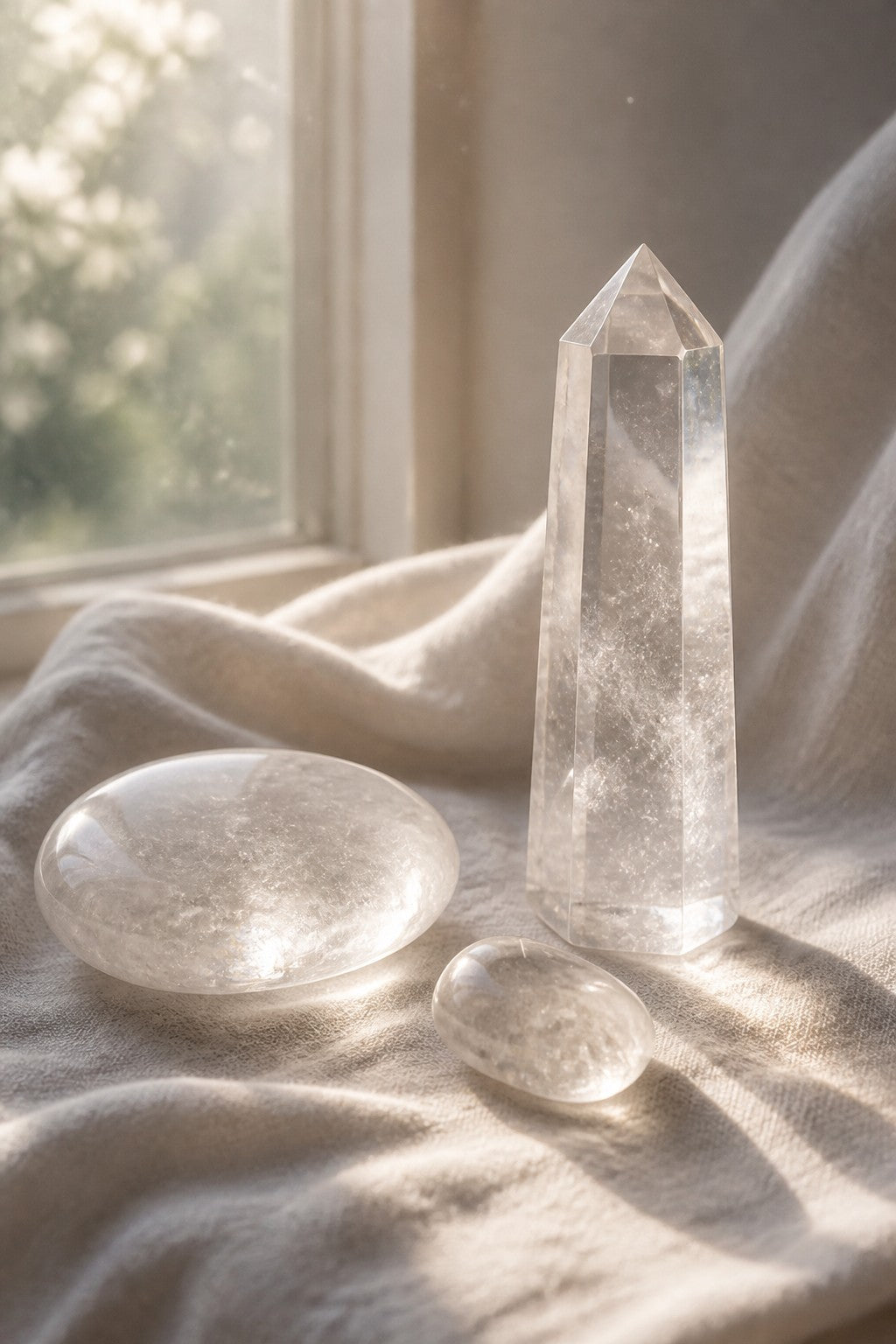
When people talk about crystals, they usually talk about the mineral first. Amethyst, rose quartz, citrine, black tourmaline. That makes sense, because the stone itself is the heart of the relationship. Yet anyone who has stood in front of a crystal table knows there is a second question that arrives right after the first: which shape?
The same amethyst can come as a small tumbled pebble, a smooth palm stone, a standing tower, a raw point or a sparkling cluster. Each one invites a different kind of use. Choosing the shape that fits your day is often the difference between a crystal that becomes a companion and a crystal that gathers dust on a shelf.

This guide walks through the most common shapes, what each is good for in daily life, and a few honest questions to help you choose. If you are brand new, you may also enjoy Choosing Your First Crystal by Intention, which focuses on the stone rather than the form.
Why shape matters at all
Shape changes how often you touch a stone, where you keep it, and how you relate to it. A pocket stone travels with you through traffic, meetings and grocery lines. A tower stays home and becomes part of the room. A cluster tends to be admired more than handled. None of these is better. They simply serve different moments.
Think of shape as the doorway into a habit. If your intention is to feel more settled during a busy workday, a stone that lives in a desk drawer at home will not help much. If your intention is to create a peaceful corner for evening reflection, a tiny pebble lost in a bag may not hold the space you want. Matching shape to intention keeps the practice simple and real.
Tumbled stones: the everyday companion
Tumbled stones are small pieces of crystal that have been rolled with grit until they become smooth and rounded. They are usually the most affordable way to begin, and they come in nearly every mineral you can imagine.
Tumbled stones shine in a few situations:
- Carrying a stone in a pocket, purse or coat as a small reminder of an intention.
- Building a simple grid or arranging stones by color on an altar.
- Trying several minerals before deciding which ones you truly connect with.
- Sharing stones with children or friends, since they are sturdy and easy to hold.
A small tumbled stone such as the Amethyst Tumbled Pocket Stone is a lovely way to start. Hold it when you notice your thoughts racing, roll it between your fingers while you breathe slowly, and let it be a touchstone that brings you back to the present moment.
The only real drawback is size. Tumbled stones are easy to misplace, so give yours a home: a little dish by the door, a pouch, or a specific pocket.
Palm stones: something to hold
Palm stones are flat, oval stones polished to fit comfortably in the hand. Many have a gentle thumb hollow. They are larger than tumbled stones, so they feel more substantial, and they are made for touch.
Palm stones are wonderful for:
- Meditation, when you want something steady to rest your hands on.
- Evening wind down rituals, where holding a smooth weight helps the day feel finished.
- Journaling sessions, held in the free hand between sentences.
- Moments of nervous energy, when the hands want something to do.
Because of their size, palm stones usually stay home or travel in a bag rather than a pocket. They are less about being carried and more about being held on purpose.
Towers and points: anchors for a space
Towers are polished stones cut into a standing column with a pointed top. Raw points are natural crystal formations that grew into that shape on their own. Both stand upright, which gives them a strong visual presence.
People often place towers on desks, bookshelves, nightstands or altars as a focal point. A tower can mark the center of a crystal grid, act as a visual anchor in a meditation corner, or simply remind you of an intention every time your eyes land on it. You can read more about grids in Crystal Grid Basics for Calm.
When choosing a tower, look at the base. A stable, flat base matters more than the height. A tall tower with a narrow base can topple if a cat or a curious child brushes past it.
Clusters and geodes: the room holders
Clusters are groups of crystal points that grew together from a shared base. Geodes are hollow rock shells lined with crystals inside. Amethyst is especially loved in both forms.
Clusters and geodes are rarely carried. They are placed. They catch light beautifully, so a windowsill or a lamp lit shelf shows them at their best. Many people like to set smaller stones on top of a cluster between uses, simply as a ritual of rest for the collection.
Because clusters have many small points, they can chip if bumped or cleaned roughly. Dust them with a soft brush and keep them away from busy edges.
Spheres: the quiet shape
Spheres are polished into perfect rounds. They have no front or back, no point and no edge. That makes them feel calm and complete. Spheres look beautiful on small stands and are pleasant to hold in both hands during a slow breath practice. Place a sphere on a stand rather than loose on a shelf, because a round stone will roll.
Five questions to help you choose
If you feel pulled toward several shapes at once, these questions can help.
- Where will this stone live most of the time? Pocket, desk, nightstand, altar or window.
- Will I touch it daily or mostly look at it? Touch points to tumbled or palm stones. Looking points to towers, clusters and spheres.
- What is my intention, in one sentence? Write it down. Then imagine the stone in the place where that intention matters most.
- Who else shares this space? Pets, toddlers and busy hallways favor sturdy, low shapes.
- What feels good in my hand? Your own response is valid information. If a stone feels pleasant to hold, that matters.
Caring for each shape
Every shape benefits from gentle care. Tumbled and palm stones can collect oils from hands, so a soft cloth wipe keeps them bright. Towers and clusters collect dust, so a dry brush is your friend. Some minerals do not like water at all, so check before rinsing. For a full walk through of cleansing methods, see How to Cleanse Your Crystals.
Many people also like to set a gentle intention when they bring a new stone home. That might mean holding it for a few breaths, saying a simple sentence about why you chose it, and then placing it in its new spot. It is a small ceremony that turns a purchase into a relationship.
Building a collection slowly
There is no need to own every shape. Many thoughtful collections grow slowly over years. A common and lovely path is to begin with one or two tumbled stones, then add a palm stone for meditation, then later bring home a tower or cluster for a special corner.
If you would like a simple way to begin with several minerals at once, the 7 Chakra Stone Kit with Selenite Wand gathers seven tumbled stones in one place, which makes it easy to notice which colors and textures you reach for most.
A gentle closing thought
Crystals are companions for attention. The shape you choose decides where that attention will happen: in your pocket on a hard day, in your palm during a quiet breath, or on a shelf that greets you each morning. Choose the shape that fits your real life, not an imagined one, and let the practice stay small enough to be kind.
If you want to keep learning, explore the stone guides in the Free Light Library, starting with Amethyst: A Gentle Guide to the Calm Stone.
Can we pray for you?
Fill out a request here, and we will gently hold your prayer, intention, or gratitude in light.


