


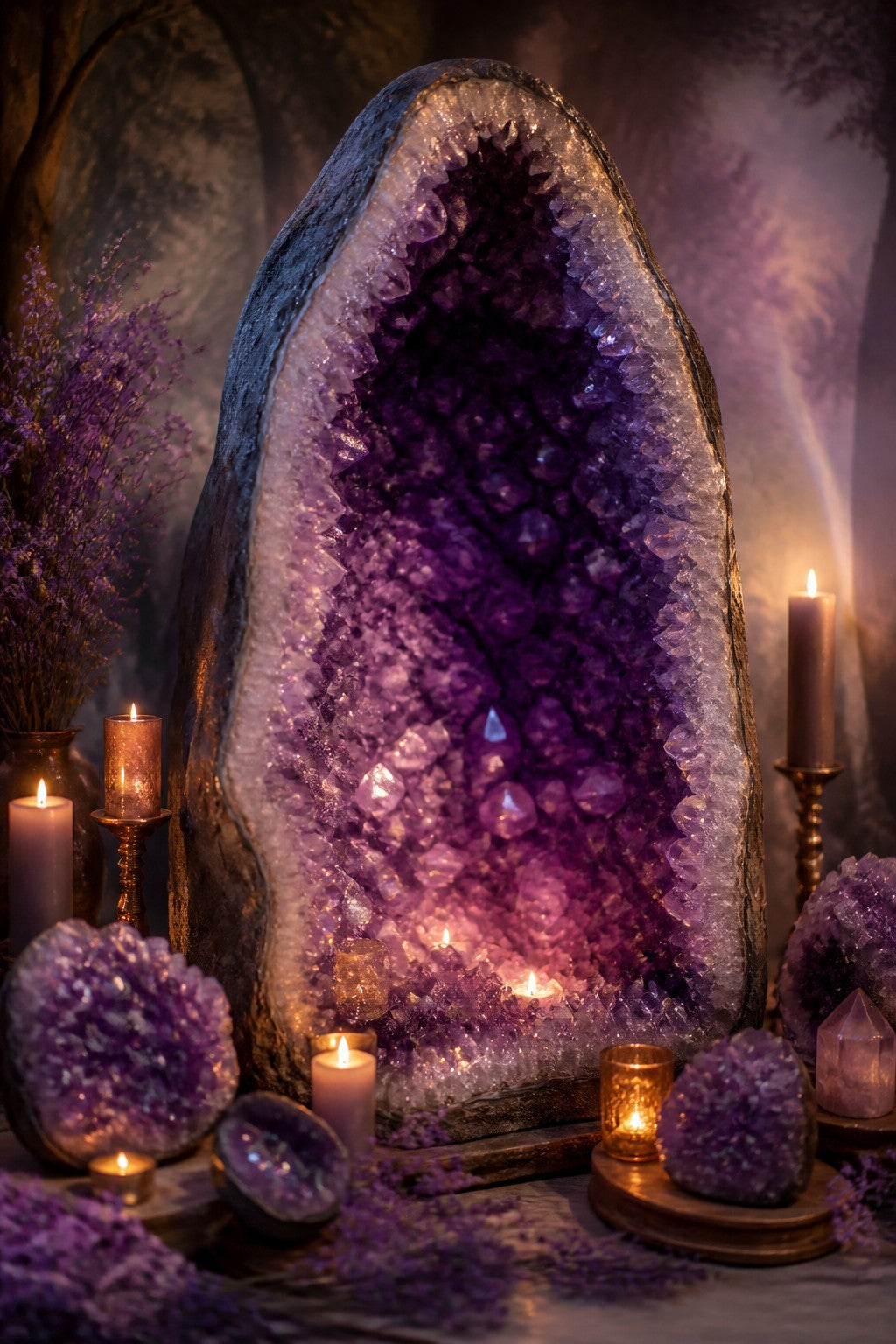
Amethyst is one of the most beloved crystals in the world. Its purple color ranges from pale lavender to deep violet, and it appears in more forms than almost any other stone. Walk into a crystal shop and you may see small clusters, cut base geodes, towering cathedrals, single points, agate slices and polished spheres, all labeled amethyst.
The names can be confusing, especially if you are new. This guide explains what each form actually is, how it formed or was shaped, and how people tend to use it at home. If you want to learn about the stone's traditional associations first, start with Amethyst: A Gentle Guide to the Calm Stone.

How amethyst grows
Amethyst is a purple variety of quartz. It often forms inside hollow spaces in volcanic rock. Over a long period of time, mineral rich water moves through these spaces, and quartz crystals slowly grow inward from the walls. Traces of iron and natural conditions inside the earth give the crystals their purple color.
This growth pattern explains most of the forms you see for sale. Some pieces are whole hollow pockets. Some are broken sections of the pocket wall. Some are single crystals pulled from the group. Others are cut and polished by people.
Clusters
An amethyst cluster is a group of crystal points that grew together on a shared base. It is usually a section of the inner wall of a larger pocket.
Clusters are loved because every point catches the light. Small clusters fit easily on a desk or nightstand. Medium clusters suit bookshelves and altars. Many people like to set smaller tumbled stones on top of a cluster between uses, as a resting place for the collection.
An Amethyst Cluster is a lovely first piece if you want something that feels alive and sparkly without taking up much space.
Geodes
A geode is a rounded rock that is hollow inside and lined with crystals. From the outside, many geodes look like plain stones. When they are opened, the purple interior is revealed.
You will often see the phrase cut base geode. This means the bottom of the geode has been sliced flat so it can stand upright, opening facing forward like a little cave. These are very popular for shelves and altars because they are stable and show the inside clearly.
Geodes carry a beautiful symbolic message. Something ordinary on the outside can hold great beauty within. Many people keep a geode nearby as a reminder of their own hidden depth.
Cathedrals
An amethyst cathedral is a tall geode, usually standing upright, that has been opened along one side so you can see the crystal lined interior from top to bottom. The name comes from their height and the way the inside resembles an arched chamber.
Cathedrals range from tabletop pieces to dramatic pieces taller than a person. Larger cathedrals are statement pieces, often placed in entryways, studios or meditation rooms as the anchor of the whole space. Because of their weight, they need a stable floor or very sturdy furniture.
Points
An amethyst point is a single crystal, either natural or polished, with a pointed tip. Natural points are often pulled from clusters. Polished points have been shaped and shined by hand or machine.
Points are versatile. People use them at the center of a crystal grid, hold them during meditation, or line them up on a windowsill. A single point is often the easiest amethyst to travel with.
Towers
A tower is a polished stone cut into a standing column with a faceted tip. Towers are shaped by people rather than grown in that form. They are favored as focal pieces because they stand tall and show off color banding.
Banded amethyst towers show stripes of purple and white. These bands are part of the natural stone and can be very beautiful in a polished form.
Agate slices and plates
Some amethyst grows within agate, which is a banded form of chalcedony. When this stone is sliced thin and polished, it shows rings of agate around a center of sparkling amethyst. These slices are often used as coasters, altar plates or small trays to set other stones on.
Tumbled stones and palm stones
Tumbled amethyst is made by rolling small pieces with grit until they are smooth. Palm stones are larger flat polished stones shaped to rest in the hand. Both are made for touch and carry. You can learn more in our guide to choosing a crystal shape.
Which form is right for you
The best amethyst for you depends on where it will live and how you want to relate to it.
- For a desk or nightstand: a small cluster, point or cut base geode.
- For daily carry: a tumbled stone or small point in a pouch.
- For meditation: a palm stone or point to hold.
- For an altar centerpiece: a geode or tower.
- For a whole room presence: a cathedral.
Size is a matter of taste and space, not of spiritual value. A small piece you look at every day can mean much more than a large one you rarely notice.
Caring for amethyst
Amethyst can fade if left in strong direct sunlight for long periods, so it is best kept out of sunny windows. Clusters and geodes can collect dust in their many crevices. A soft makeup brush or a gentle puff of air works well. Avoid harsh cleaners.
For energetic cleansing methods that suit amethyst, see How to Cleanse Your Crystals.
A simple amethyst evening ritual
Many people place amethyst near the bed. If you would like a small ritual, try this:
- Sit near your amethyst before sleep.
- Look at its color for a few slow breaths.
- Name one thing from the day you are ready to set down.
- Imagine placing that thing gently inside the geode or among the points, to rest there overnight.
- Turn off the light.
This is not about the stone taking anything away. It is about giving your mind a clear symbolic moment to let the day end.
Closing thought
Every form of amethyst carries the same quiet color, and every form tells a slightly different story. The cluster speaks of community. The geode speaks of hidden beauty. The cathedral speaks of sacred space. The point speaks of focus. Choose the story that you want to live with, and let your amethyst be a calm reminder of it.
Explore more gentle crystal guides in the Free Light Library.
Can we pray for you?
Fill out a request here, and we will gently hold your prayer, intention, or gratitude in light.


