


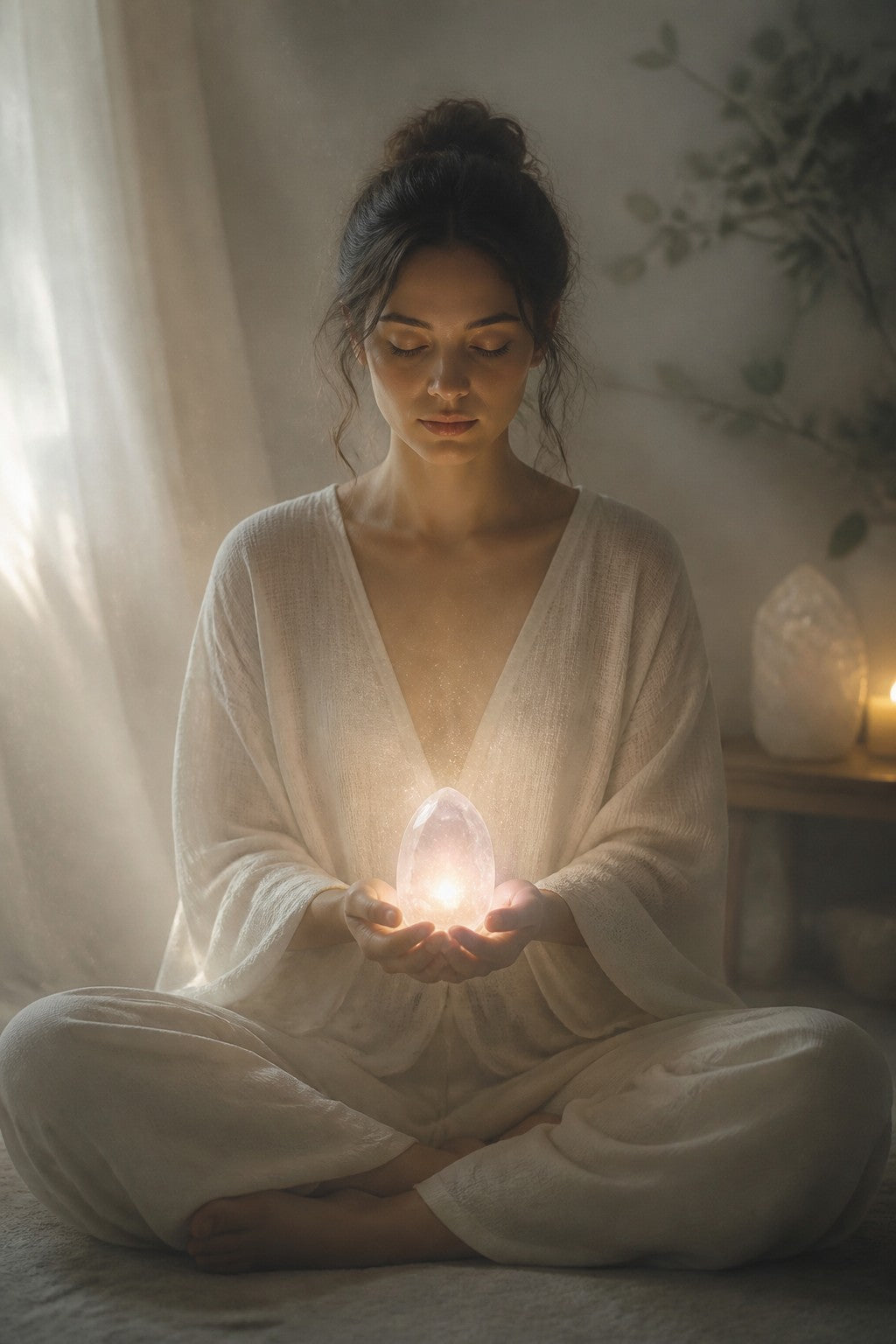
Many people find meditation easier when they have something to hold. A crystal offers a natural focus: it has weight, texture, temperature and color. Holding a stone can gently anchor your attention in the present moment, especially when the mind feels busy.
Crystal meditation is simple and suitable for beginners. You do not need a large collection or special knowledge. One stone and a few quiet minutes are enough. This guide explains how to choose a crystal, prepare your space and practice several gentle crystal meditations.

What is crystal meditation?
Crystal meditation is any meditation practice that includes a crystal as a point of focus. You might hold it in your hand, rest it on your body or place it in front of you to gaze at. The stone becomes an anchor, much like the breath or a candle flame in other practices.
Many people also enjoy the symbolic meanings traditionally linked with different stones. Amethyst is often associated with calm, rose quartz with love and clear quartz with clarity. These associations can help you set an intention. The experience itself, however, is about simple, attentive presence.
Choosing a stone
Choose a crystal that feels comfortable to hold. A smooth palm stone or tumbled stone works especially well. Some popular choices:
- Clear quartz, often called the master stone, for clarity. Read Clear Quartz: A Gentle Guide to the Master Stone.
- Amethyst, for a sense of peace.
- Rose quartz, for warmth and compassion.
- Smoky quartz or black tourmaline, for grounding.
- Selenite, for a light, airy feeling.
If you are unsure, pick the stone you feel drawn to. Trust your instinct. Our guide to Palm Stones, Tumbled Stones and Towers explains which shapes suit which uses.
Preparing your crystal
Many people like to cleanse a crystal before meditation. This is a symbolic act of clearing and setting intention. Simple methods include holding it in incense smoke, placing it on a selenite plate or setting it in moonlight. Read How to Cleanse and Charge Your Crystals.
Preparing your space
- Choose a quiet place where you will not be disturbed.
- Sit comfortably on a chair or cushion.
- Dim the lights or light a candle.
- Silence your phone.
- Set a gentle timer for five to fifteen minutes.
Practice one: holding meditation
This is the simplest crystal meditation.
- Hold your crystal in one or both hands, resting in your lap.
- Close your eyes or soften your gaze.
- Take three slow breaths.
- Bring your attention to the stone. Notice its weight.
- Notice its temperature. Is it cool or warm?
- Notice its texture. Is it smooth, rough, ridged?
- Let your breath flow naturally as you continue noticing.
- When your mind wanders, gently return to the sensations of the stone.
- When the timer sounds, take a deep breath and open your eyes.
Many people notice the stone slowly warming to the temperature of their hands. Simply observing that change can be quietly absorbing.
Practice two: gazing meditation
- Place the crystal in front of you at eye level or slightly below.
- Rest your eyes on it.
- Notice its colors, inclusions, reflections and shape.
- Let your gaze soften.
- If your eyes tire, close them and picture the stone in your mind.
- Open your eyes and gaze again.
This practice is similar to Candle Gazing Meditation and can be calming for visual people.
Practice three: intention meditation
- Hold your crystal and take a few breaths.
- Choose one word or phrase as an intention, such as "peace," "clarity" or "I am open to love."
- Silently repeat the intention as you breathe.
- Imagine the intention gently filling the stone and your body.
- Sit quietly for a few minutes.
- Afterward, place the stone somewhere you will see it as a reminder.
Practice four: lying down meditation
- Lie on your back on a mat or bed.
- Place a smooth stone gently on your chest or belly.
- Feel it rise and fall with your breath.
- Let your attention rest on the movement.
- Remain for five to ten minutes.
This can be especially relaxing before sleep.
Common experiences
During crystal meditation, people report a range of experiences:
- A sense of calm.
- Warmth or tingling in the hands.
- Wandering thoughts.
- Sleepiness.
- Emotions arising.
All of these are normal. There is no right experience. Meditation is simply about returning gently to the present moment.
When the mind wanders
Your mind will wander. That is what minds do. Each time you notice it, gently bring your attention back to the stone. This returning is the heart of meditation. Read Meditation for Beginners (No Pressure) for more reassurance.
Sharing the practice
Crystal meditation is easy to share with family and friends. Children often enjoy choosing a stone and noticing how it feels. Partners or friends can sit together, each holding their own crystal, for a few quiet minutes. Afterward, you might each describe one thing you noticed about your stone.
Building a routine
Start with five minutes a day. Choose a consistent time, such as morning or before bed. Keep your crystal in a special place near your meditation spot. Over time, simply picking up the stone may help you settle more quickly.
Using a crystal throughout the day
After meditation, you can carry the crystal in your pocket. When you touch it during the day, it can remind you to breathe and return to the calm you felt. A smooth stone such as an Amethyst Palm Stone fits nicely in the hand for this purpose.
A gentle note
Crystal meditation is a spiritual and relaxation practice. It is not a substitute for professional medical or mental health care. Enjoy it as one part of a balanced, caring life.
Closing thought
A crystal can be a quiet companion on your meditation path. Its weight, texture and beauty invite you into the present moment. Choose a stone, find a quiet spot and spend a few minutes simply noticing. You may be surprised by how much peace a small stone can hold.
Can we pray for you?
Fill out a request here, and we will gently hold your prayer, intention, or gratitude in light.


