


Few sky events stop people in their tracks like an eclipse. In a few quiet minutes, the familiar sun or moon changes before our eyes, and people across history have gathered to watch.
Solar eclipses
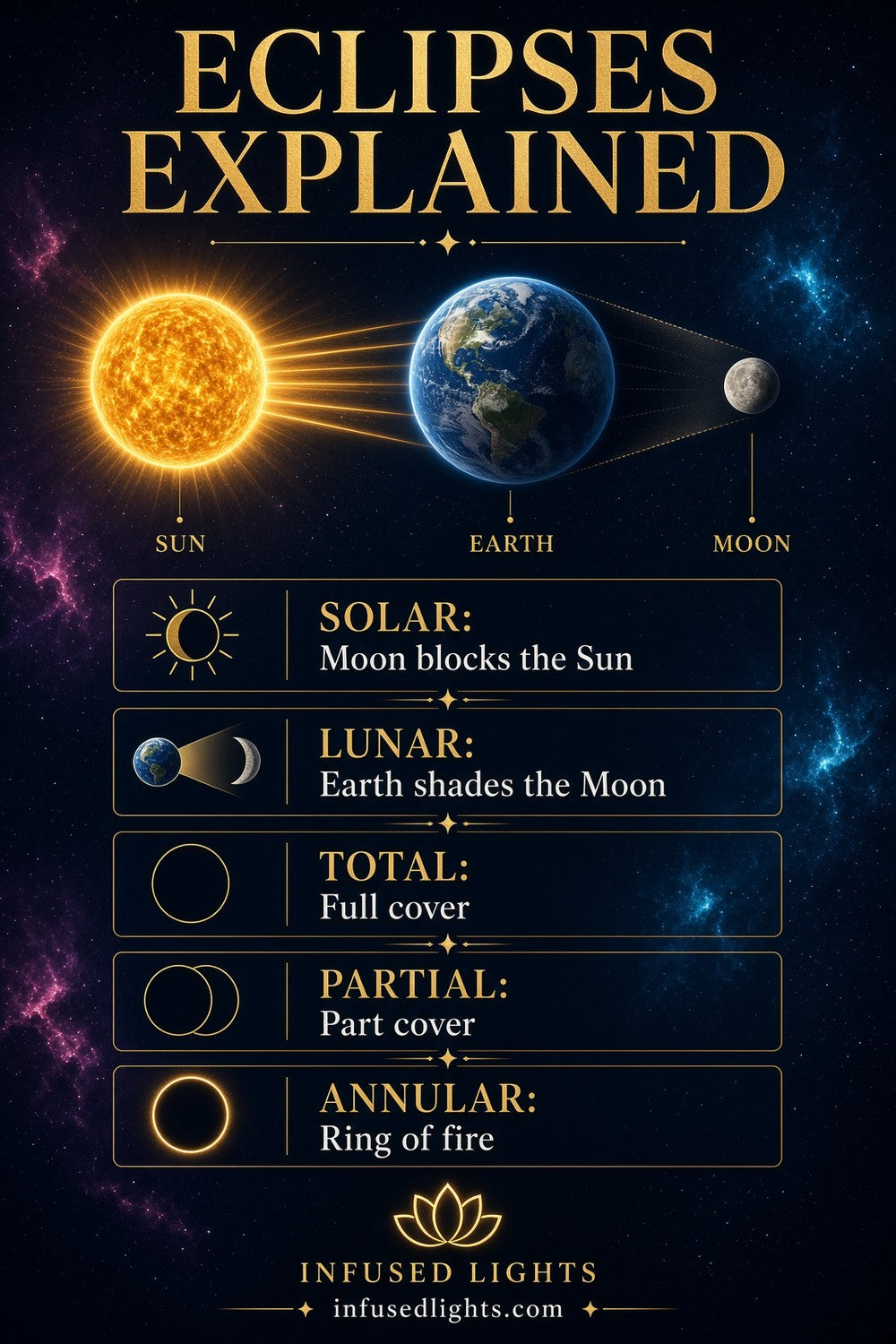
A solar eclipse happens when the moon passes between the Earth and the sun, casting its shadow on us. It can only happen at new moon. In a total eclipse the moon covers the sun completely and the sky darkens; in a partial eclipse only part is covered; and in an annular eclipse the moon is a little farther away, leaving a bright ring of fire.
Always use certified eclipse glasses or a pinhole projector to view a solar eclipse. Looking at the sun directly is never safe, even when it is mostly covered.

Lunar eclipses
A lunar eclipse happens at full moon, when the Earth sits between the sun and moon and our shadow falls across the lunar surface. During a total lunar eclipse the moon often glows a deep copper red, lit by sunlight bending through Earth's atmosphere. Lunar eclipses are safe to watch with the naked eye.
Why they feel so special
Eclipses remind us that we live on a moving world in a vast, orderly cosmos. Many people like to journal or sit quietly during one. For more sky wonder, read Cosmic Wonder Without the Circus or explore your astrology star map.
Questions people ask
Is it safe to look at a solar eclipse?
Only with certified eclipse glasses or a pinhole projector. Never look directly at the sun.
Why does the moon turn red during a lunar eclipse?
Sunlight bends through Earth's atmosphere and reaches the moon with a copper red glow.
How often do eclipses happen?
Several eclipses happen around the world each year, though any one place sees a total solar eclipse only rarely.
Related reads


Try a free reading: Meet Your Guardian Angel · Chakra Check · Starseed Origin · Lightworker Type · Find a healer or guide in the Light Network
Can we pray for you?
Fill out a request here, and we will gently hold your prayer, intention, or gratitude in light.


