


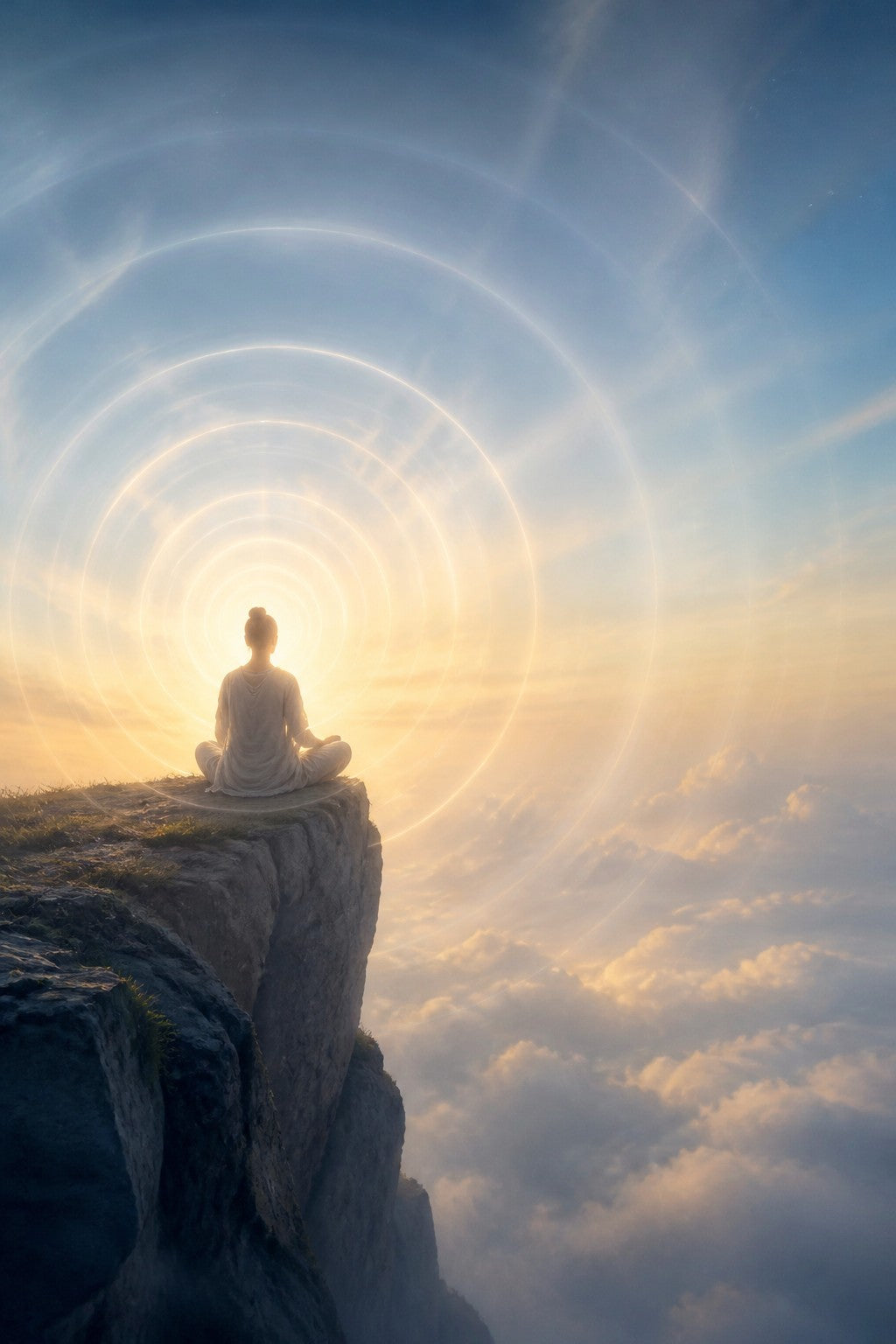
Most meditation practices begin with a single focus, such as the breath, a candle or a mantra. Open awareness meditation is different. Instead of narrowing attention to one object, you widen it to include everything: sounds, sensations, thoughts and feelings, all arising and passing in a spacious field of awareness.
This style of meditation is sometimes described as choiceless awareness or open monitoring. It can feel freeing, like stepping out of a small room into a wide open landscape. This guide explains what open awareness is, how to practice it and how to make it accessible for beginners.

Focused versus open attention
There are two broad styles of meditation:
- Focused attention: you choose one anchor, such as the breath, and gently return to it when the mind wanders.
- Open awareness: you rest in awareness itself, noticing whatever arises without holding on to any one thing.
Both are valuable. Many people begin with focused attention to settle the mind, then move into open awareness. Read Breath Counting Meditation for a focused practice that pairs well with this one.
Why practice open awareness?
People who practice open awareness often describe:
- A sense of spaciousness and ease.
- Less tendency to get caught in thoughts.
- Greater appreciation for ordinary moments.
- A feeling of being part of something larger.
It can also help you notice how experiences come and go, which some find calming.
Preparing
- Sit comfortably with your back upright but relaxed.
- Rest your hands in your lap.
- Keep your eyes closed or open with a soft gaze.
- Take a few slow breaths.
The practice
Begin with an anchor
For the first few minutes, rest your attention on your breath. Feel it moving in and out. This helps the mind settle.
Widen to the body
Gradually expand your attention to include the whole body. Notice sensations wherever they are: warmth, coolness, pressure, tingling. Let them be.
Widen to sounds
Now include sounds. Notice near sounds and far sounds. Let them arrive and fade without labeling them as good or bad. The Rain Listening Meditation is a lovely way to practice this step.
Widen to thoughts and feelings
Include thoughts and emotions as well. When a thought appears, notice it like a cloud passing across the sky. You do not need to follow it or push it away. Simply notice and let it move on.
Rest in awareness
Now rest in the space in which all of these experiences appear. Imagine awareness as wide as the sky. Sounds, sensations and thoughts are like weather passing through. The sky remains open and spacious.
Stay here for several minutes.
Returning
When you are ready, gently bring your attention back to the breath. Feel your body. Open your eyes slowly. Take a moment before moving on.
Helpful images
Some images can make open awareness easier to understand:
- Sky and clouds. Awareness is the sky. Experiences are clouds.
- Ocean and waves. Awareness is the ocean. Thoughts are waves rising and falling.
- A wide room. Awareness is a room with open windows. Everything is welcome to come and go.
When you get lost in thought
You will get lost in thought sometimes. That is natural. When you notice, simply return to the wide view. You might briefly return to the breath to steady yourself, then open again.
Starting small
Open awareness can feel vague for beginners. Start with short sessions of five minutes. Spend most of the time on the breath, then open for the last minute or two. Gradually extend the open portion as it becomes familiar.
Open awareness in daily life
You can practice open awareness anywhere:
- Sitting outdoors: notice everything around you without focusing on one thing.
- Walking: take in sights, sounds and sensations as a whole. Read Walking as Moving Meditation.
- Waiting: instead of reaching for your phone, rest in open awareness for a few breaths.
- Listening to music: let the whole sound wash over you.
Creating a supportive space
A calm environment helps. Consider sitting near a window with a view of the sky. Some people like to begin with a sound, such as a singing bowl, and follow the tone as it fades into silence, then rest in the silence. A bowl such as the Lin Guai Hand Hammered Tibetan Singing Bowl can be a beautiful way to open a session.
Common challenges
Feeling unfocused
Open awareness can feel like drifting. If it does, return to a focused anchor for a while.
Sleepiness
Sit more upright, open your eyes or practice at a more alert time of day.
Overwhelm
If too many experiences arise at once, narrow your focus to the breath or a single sound. It is fine to move back and forth.
Doubt
You may wonder whether you are doing it right. There is no perfect way. If you are noticing what arises, you are practicing.
Combining practices
A balanced meditation session might include:
- Five minutes of breath focus.
- Five minutes of open awareness.
- A short loving kindness practice to close.
Read Loving Kindness Meditation: A Simple Guide.
Journaling after open awareness
After a session, you might spend a few minutes writing. What did you notice? Which sounds, sensations or thoughts came and went? Did the sense of space feel easy or difficult today? Writing helps you see patterns over time and can deepen your appreciation of the practice. Some people find that their notes reveal a gradual softening, a growing ease with whatever arises.
A gentle reminder
Open awareness is not about achieving a special state. It is about noticing what is already here. Some sessions will feel spacious, others busy. All are part of the practice.
Closing thought
Open awareness meditation invites you to step back and see the whole sky rather than only the clouds. With practice, this spacious view can bring a sense of ease into daily life. Start small, be patient and enjoy the openness.
Can we pray for you?
Fill out a request here, and we will gently hold your prayer, intention, or gratitude in light.


